The Generative AI Revolution in Multimedia
Generative Artificial Intelligence (AI) is not merely a transient technological development—it is a profound revolution reshaping the multimedia industry from its core. It serves as a driving force for creativity, productivity, and personalization, while simultaneously presenting complex challenges related to originality, intellectual property, and ethical use. How we address these challenges and seize the opportunities will define the future of the industry.
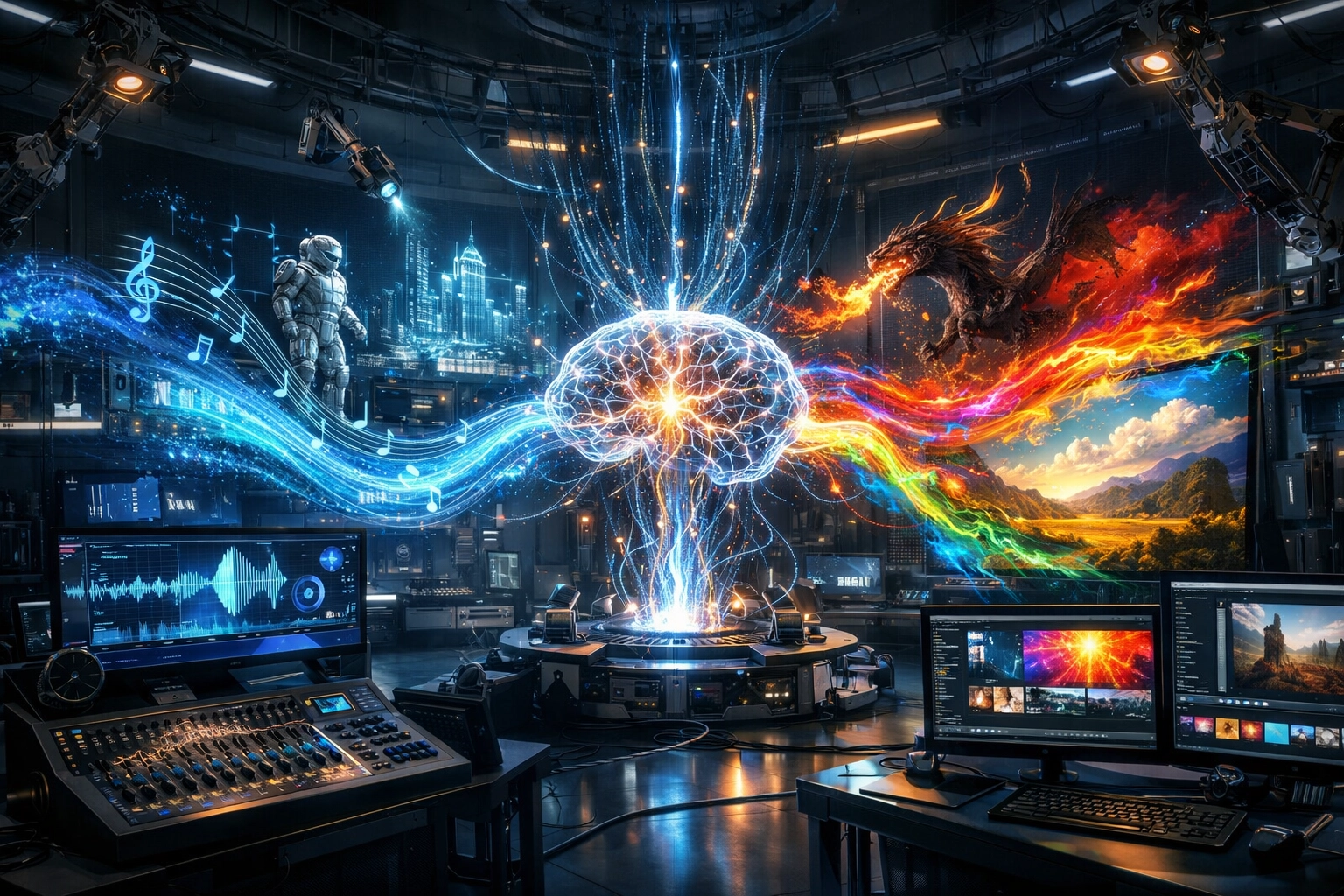
In recent years, AI has experienced unprecedented growth, most notably through the development of generative AI models. These technologies have the capacity to create entirely new and original content—text, images, videos, and even music—causing a seismic shift across multiple industries, with multimedia taking a leading role in this transformation.
AI has evolved from being a mere assistant to becoming a true creative partner, redefining the concepts of creativity and production in the digital age.
From Automation to Co-Creation
Previously, AI tools in multimedia primarily focused on automation and enhancement tasks, such as image quality improvement, noise removal from audio, or basic video editing. The emergence of models like GPT-3, DALL·E, Midjourney, and Stable Diffusion has fundamentally changed the game. These tools no longer just process existing content—they can generate entirely new material from simple text prompts. For example, AI image generators can transform a prompt like “A neon-lit futuristic city at night, in a cyberpunk art style” into a stunning visual in seconds. Similarly, generative text models can write scripts, stories, or full articles, providing creators with either a strong starting point or a ready-to-publish product.
This represents a paradigm shift from simple automation to human-AI co-creation. AI is no longer just an executor of commands—it can contribute ideas, explore alternative creative patterns, and even challenge conventional notions of creativity. This accelerates production, reduces costs, and empowers individuals and small companies to produce high-quality content that previously required large teams and budgets.
Impact on Creators: Empowerment, Challenges, and Role Redefinition
The impact of generative AI on creators is multifaceted. On one hand, it is a powerful enabling tool: designers, artists, writers, and video producers can accelerate workflows, experiment rapidly, and overcome technical barriers. For instance, a graphic designer can generate dozens of logo or background options within minutes, refining them manually afterward. A screenwriter can generate dialogues or subplots, freeing them to focus on the more complex aspects of storytelling.
On the other hand, generative AI raises significant challenges, particularly concerning originality and human creativity. If AI can produce high-quality art, music, and text, what remains the role of the human creator? Will creators become mere prompt engineers? This challenge pushes creators to redefine their roles, emphasizing uniquely human contributions—emotional depth, cultural context, and storytelling that resonates on a human level. The creator’s role increasingly focuses on guidance, refinement, and adding the human touch that gives true value to creative works.
Intellectual property is another major concern. Since AI learns from vast datasets, including copyrighted works, questions arise about ownership: does the generated work belong to the programmer, the artist who trained the model, or the user providing the prompt? Legal frameworks are still evolving to address these issues.
There are also concerns about job displacement in some creative roles. While AI can perform certain tasks more efficiently, potentially reducing demand for some positions, it also creates new roles, such as prompt engineers, AI UX designers, and AI ethics analysts. Adapting to these changes and acquiring new skills will be critical for future creators.
The Future of Audio-Visual Production: Limitless Possibilities
The future of visual and audio production with generative AI is promising. In video, AI can significantly reduce time and costs, generate realistic shots, edit scenes, and create complex visual effects with minimal effort. Independent filmmakers, YouTube content creators, and small companies can produce professional-quality content without massive budgets or large teams. AI also enables content personalization, adapting video elements—such as language or visual details—to individual viewer preferences.
In audio and music, AI offers composers and producers new horizons: generating original tracks in different styles, creating realistic sound effects, and even simulating complex musical instruments. This accelerates production, inspires new ideas, and allows exploration of musical styles previously unattainable. AI can also enhance sound quality, remove noise, or reconstruct missing audio in archival recordings.
Integrating generative AI with Virtual Reality (VR) and Augmented Reality (AR) creates unprecedented experiences. Users can interact with AI-generated virtual worlds, where environments, characters, and narratives adapt dynamically to their actions. This opens new opportunities for entertainment, education, and therapy, delivering personalized experiences tailored to individual needs.
However, this future comes with challenges. As AI generates increasingly realistic content, concerns rise over misinformation and deepfakes, which can undermine media trust and pose national security risks. Developing detection tools and educating the public on these risks will be essential.
Challenges and Opportunities in the Generative AI Era
Generative AI brings enormous creative and productivity potential, but it also poses challenges:
Data quality: AI models depend heavily on training data. Biased, inaccurate, or low-quality data leads to flawed outputs. High-quality, diverse datasets and verification mechanisms are critical.
Technical complexity: While user interfaces have improved, achieving optimal results requires understanding how these models work and crafting effective prompts, creating a skills gap between casual users and professionals. Training, educational resources, and more intuitive tools are key to democratizing access.
Creative opportunities: AI enables unprecedented personalization. Media platforms can generate content tailored to individual interests, increasing engagement. AI can also help preserve and revive cultural heritage, restore historical media, and even generate art in the style of past artists.
Business Models and Revenue Impact
Generative AI transforms not only creative and technical processes but also business models. Lower costs and faster production allow early adopters to create more content at higher quality and lower expense, gaining competitive advantage. New business models emerge, such as on-demand AI-generated content or platforms enabling creators to sell AI-assisted works. AI can also enhance targeted advertising, increasing revenue potential.
Nevertheless, concerns remain about content value: if creation becomes too easy and cheap, content saturation may reduce its perceived worth. Quality, originality, and the human touch remain critical. Creators who integrate AI effectively with their unique vision will thrive.
Education and Training
Keeping pace with AI advancements requires robust education and training. Institutions must integrate AI tools into curricula, providing students with technical, ethical, legal, and creative skills. Current creators must invest in continuous learning, understanding how to interact with AI tools, guide their outputs, and integrate them into creative workflows. Workshops, online courses, and specialized communities play a crucial role in this process.
Conclusion
Generative AI is not a passing technological trend—it is a transformative force reshaping multimedia. It empowers creators, accelerates production, and enables innovative experiences, while also posing complex ethical and legal challenges. The future is not about AI replacing human creators; it is about human-AI collaboration to produce work that was previously impossible. This is a new era of co-creation, where human vision and AI capabilities combine to unlock boundless opportunities in the multimedia world. Companies and creators who adopt this change responsibly and thoughtfully will lead this new era.